
Dr. Gustavo de Andrade
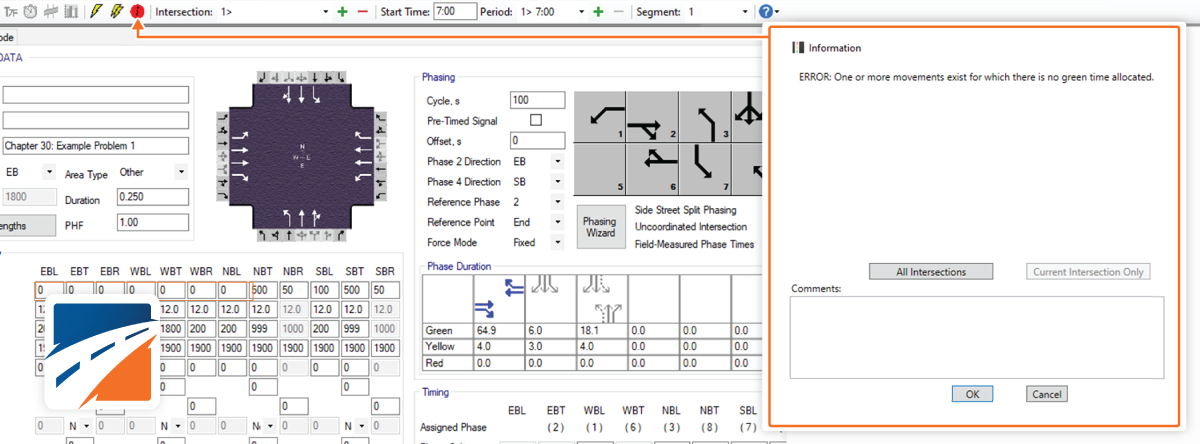
The Highway Capacity Software (HCS) Streets module comes with a Signal Optimization Tool, the only tool based on the 7th Edition of the Highway Capacity Manual (HCM) procedures for intersections and urban street segments. The optimization procedure includes lane configuration, intersection and segment characteristics, signal phasing, timing, and flow profiles to provide timing plans and corridor coordination. The input parameters optimized in the process may include cycle lengths, splits, phasing sequence, Dallas Phasing option, and offsets, as selected by the user.
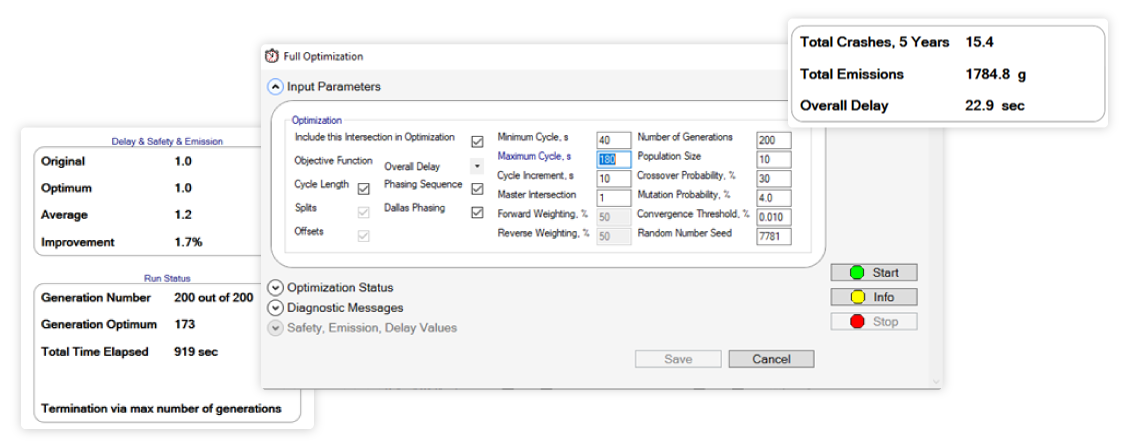
The optimization uses a Genetic Algorithm, a method based on evolution and genetics principles, which seeks the best solution by weeding out less efficient configurations while favoring ones able to optimize a chosen objective function that represents the quality of the solution. Objective functions include segment-based HCM measures, such as Percent Base FFS, arterial STOPs, and intersection-based measures, such as Overall Delay and Balanced delay.